Your mixed-breed dog or cat as a screen pet
By Aditya Trivedi ·
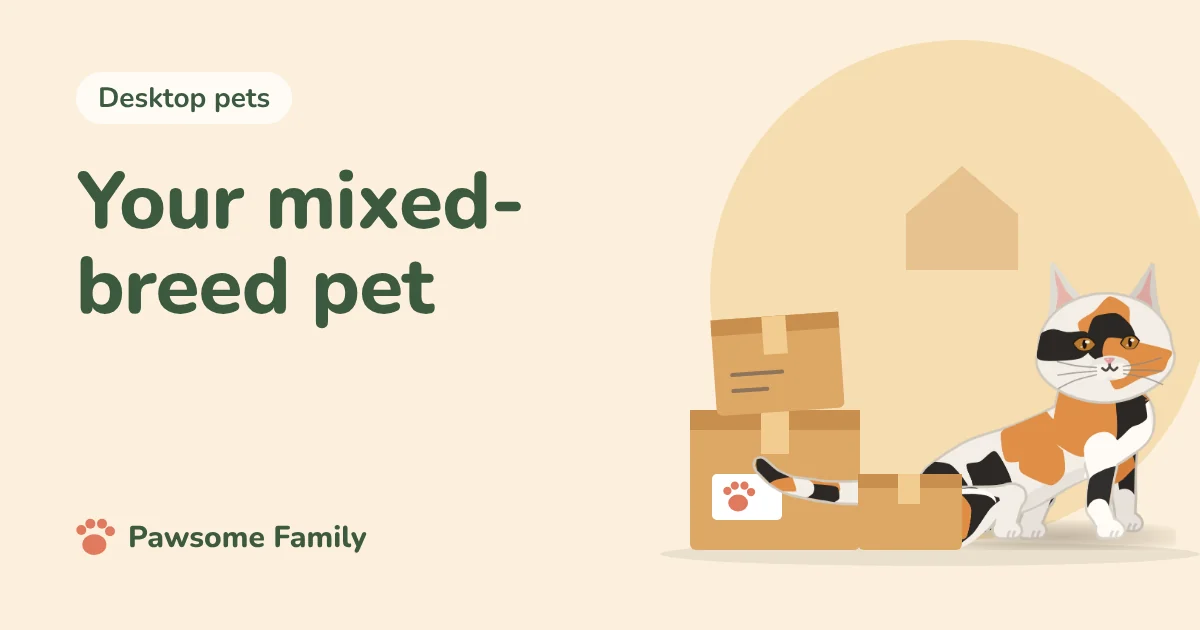
Most pets are mixes. About 95% of cats belong to no recognized breed, and about half the dogs in a large US study were mixed breed. Shelter breed labels are often wrong, too. So if your dog is “some kind of shepherd mix” or your cat is “just a tabby,” you’re in good company. To make a screen pet that looks like them, the outline and the markings in your photos matter far more than a breed name.
We make Pawsome Family, which draws a pet from photos of your own dog or cat. Mixed breeds work just as well as any breed, and here’s how to get the likeness right.
How common mixed breeds are
- Cats: the Cat Fanciers’ Association says only about 5% of cats are of any recognized breed. In the UK, an estimated 89 to 92% of cats are non-pedigree.
- Dogs: in the Dog Aging Project, a large US study of over 27,000 dogs, 50.6% were mixed breed. At shelters, a genetic study of over 900 dogs found only about 5% were purebred.
The words people use
- Domestic shorthair, longhair, semi-longhair. These aren’t breeds. They’re the labels for cats of no particular breed, sorted by coat length.
- Moggy is the British word for the same cats.
- Mutt comes from “muttonhead,” an American word for a fool from around 1900. Most owners say it with love.
Breed guesses are often wrong
Guessing a mixed dog’s breed by looking is hard, even for experts:
- In one small study, the breed a shelter named matched the main breed in the dog’s DNA only about a quarter of the time.
- In a study of over 900 shelter dogs, staff got at least one breed right 67% of the time, but when they named more than one breed, they got the mix right only 10% of the time.
So if the label on your dog’s adoption papers doesn’t look quite right, it may not be.
Patterns are not breeds
Many cat “types” people know are patterns, not breeds:
- Tabby is a pattern, with four kinds: classic swirls, mackerel stripes, spots, and ticked. All tabbies have an “M” on the forehead.
- Calico and tortoiseshell are color patterns that turn up in pedigree cats and moggies alike. They are almost always female, because the gene for orange sits on the X chromosome, and a cat needs two X chromosomes to show both orange and black.
- Orange tabbies are mostly male, for the same reason.
Making a screen pet of a mix
When there’s no breed to go on, the photos carry the likeness. In Pawsome Family, a pet with a breed takes that breed’s shape. A mix takes their shape from your photos. Their colors and markings always come from the photos.
- Take a full side view, standing. This gives the outline: leg length, body depth, tail and ears, which is what makes a mix look like your mix. See photo tips.
- Take the face straight on. The mask, the muzzle and the eye color.
- Add the other side if the markings differ, as they often do on calicos and patched dogs.
- Leave the breed empty, or type the closest one. For what matters in popular breeds and coats, see your dog’s breed as a desktop pet and your cat’s coat as a screen pet. When you meet your pet, Here’s what we saw shows what we read. Select Change next to Breed to type another, or leave it empty for a mix.
- Fix the details yourself. Ears that flop on one side, a kinked tail, a white sock: change them on your pet’s page. See how to fix how your pet looks. For everything you can change, see a custom virtual pet.
Your one-of-a-kind pet, in every tab
Pawsome Family is a desktop pet drawn from 1 to 5 photos of your own dog or cat, whatever their mix. They walk, sit and nap along the bottom of every tab in Chrome and Edge. See an example calico cat or dachshund.
One pet is free for 30 days, with no card needed.